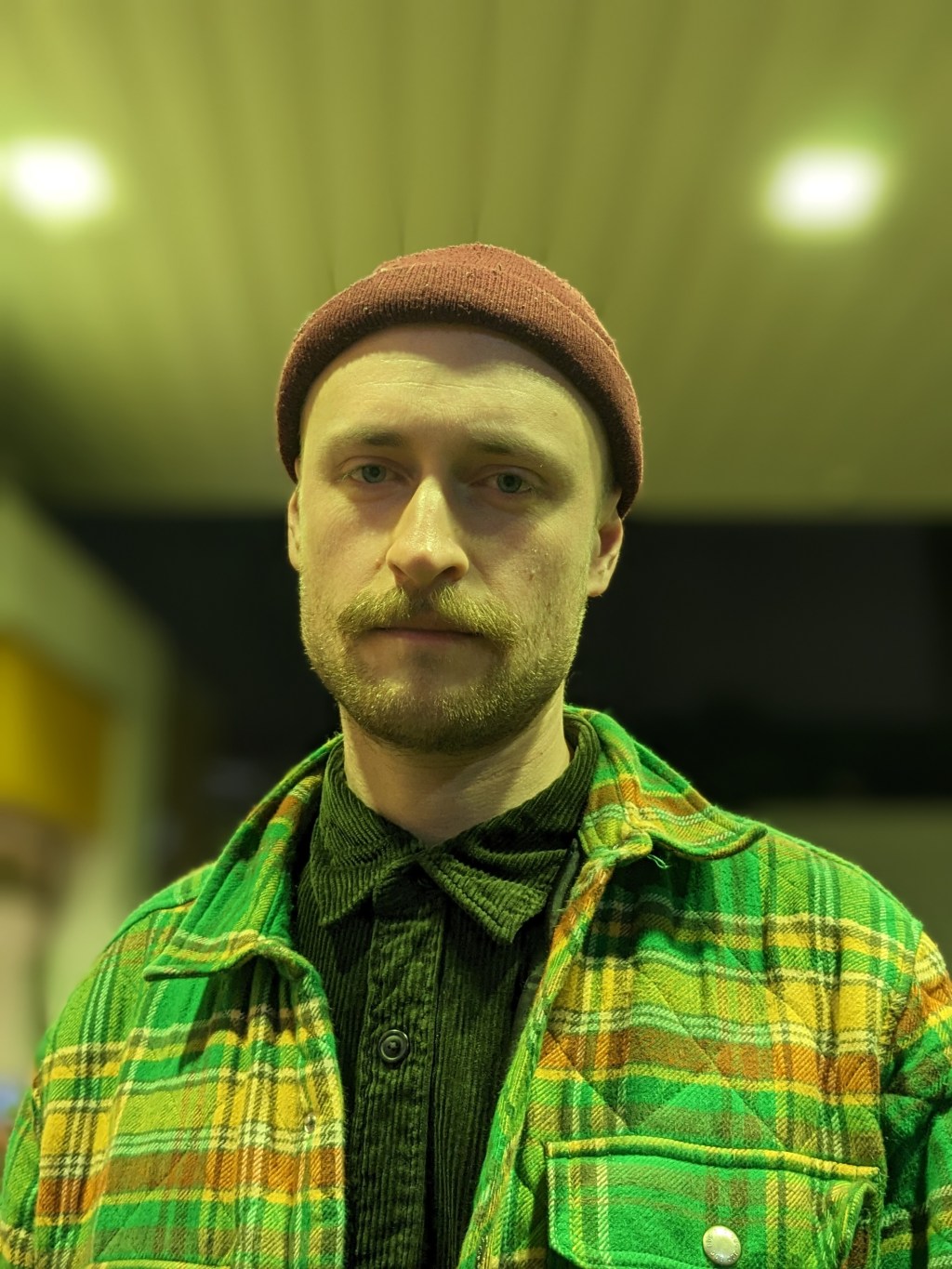
Fran has been following the career of Benedict Benjamin ever since randomly catching his set on a hungover morning at Green Man Festival many years ago, so he was very happy to sit down with the man himself for a chat about his songwriting, his influences, his kids, and his latest album. Let’s get straight to it:
Fran Slater : Hi Ben – thanks for talking to us. So, Tunnel came out on Friday – we’ve already reviewed it and you know I love it. But I’m gonna start with a question I always ask people, and they usually hate me for it. But I’ll ask anyway. So, how would you describe the album and your music more generally to people who haven’t heard you yet?
Benedict Benjamin: Oh, yeah – well hi first of all. And I get why people struggle with this question! I’m not good at describing what my music sounds like. In real life. I always think I’ll sound like a wanker, but then this is an interview for a music site, so I guess I’ll have a go
Uh, it’s become quite sort of psychedelic and post punky with this album, but there’s still a lot of folk elements to it, too. It’s all quite vulnerable I guess, it’s all sort of first person and telling stories about my own life.
I suppose when I did my first album it was all folky sounds, but always with an attempt to sound like early 60s songs. And the second album was more influenced by Garage Rock sort of stuff. But now I would say I am sort of filtering all sorts of things in there – it’s not hip hop obviously, but I was thinking that I definitely wanted to make and use loops – the sort of loops I love on Endtroducing, the DJ Shadow album.
So, I’d say that the influences and sounds are more varied this time, if that makes sense.
I mean, It doesn’t sound like Arthur Russell, but there’s a song where he plays organ and I wanted to work out that part. And then I just loved playing that part. And me sort of doing my impression of that part kind of made-up a lot of the sound of this album. I’m doing that on almost every track – ha ha.
FS: Thanks, Ben – it’s great to hear how you see the album. Can I ask a bit more about what you mean about it being vulnerable?
BB: Of course. Well, yeah, it was written during the pandemic. And I found that, during that time, the music I was turning to was from people who were being honest and open. Like there’s a guy called Owen Ashworth who I was listening to a lot back in 2009 and around then, and I just got really nostalgic for his music and what it was giving me.
It’s the music I was listening to when I felt I was coming of age, and I kind of returned to that. His songs are just incredibly open and vulnerable – really powerful – and when I was writing Tunnel it just gave me the nourishment I needed to try and write in that way. It gave me what I needed to be honest with my lyrics.
FS: That pretty much feeds into my next question, too – as I wanted to ask about how you open the album with ‘Furlough Blues.’ I think it’s an interesting way to start because it sort of puts a timestamp on the album – like you were immediately telling us where you were and when it was written. And I just wanted to ask a little bit about the context of that song being written, but also a bit about how the pandemic affected your songwriting and your music processes?
BB: That’s cool that you say that about the timestamp. I did want to do that, but I I wasn’t sure how much to do it – I didn’t want to overdo it.
To be honest, when I wrote it, I didn’t give a fuck about what anyone thought. I know people say that a lot, that it’s a common feeling when writing, but I guess I felt that a lot more than I’ve ever felt it before’ because I kind of felt like; ‘well I guess music’s over now.’ I mean, during the pandemic no one knew what the fuck was gonna happen. But even after the second album I felt that I needed to get a full time job – I felt like ‘I’ve had fun but I’m not gonna make a living from this.’
And then lockdown came and I was given all this time. I mean, there’s so much fucking horrible shit going on and obviously I had my daughter and there was like all kinds of stress – but I did have an opportunity to write. And I had time to write in a way that I did not have before lockdown. That was fucking great. And I just made music as a way of escaping for a little bit. I could just sink into it in a way that I hadn’t really done before.
But ‘Furlough Blues’ came along during that period where just things were really bad and you’d be sort of looking at your phone and the next day things would be worse. And the more you read, the deeper you got, you would get into how things were even worse – and it was just ongoing. Never ending. A horizon of shitness the whole time.
So the song is just about feeling helpless with that going on. But I really enjoy playing it. I think it’s quite a fun kind of energetic song. I’m really, really enjoying translating it to a band.
But yeah, I mean it’s like a portrait of quite a horrible time and a horrible feeling, but I guess that’s quite a good thing. Making something fun from something awful.
But to go back to your original questions, there were times when the whole thing really fucked me up. I questioned why I was writing. Audiences don’t exist. The whole music culture doesn’t exist. Is that the only reason why I do this? Or do I like it if I’m just doing this for myself and by myself and no one ever hears it? Do I still wanna do it?
And I do, but maybe I didn’t realise all that before.
F: Yeah, that makes a lot of sense and is something I’ve heard from other people, too. And while we are talking about songs that came out of a specific, life changing time – I’d like to ask you about another track. As I have a 2-year-old, you can probably imagine that ‘Nursery’ is a song that really spoke to me at the minute. I am taking my daughter into nursery three times a week right now, and we experience what you talk about in the song. She just doesn’t want us to leave at drop off time.
The first time I heard that song, I had just dropped her off that day. And actually, my partner came back the day before crying. Because she’d had the same situation, so I just sent it immediately to my partner and said you need to hear this this song. So it really spoke to me for very personal reasons.
But I wondered if you could maybe talk a little bit about the context of that song what led to your writing it. And I’m also interested in if the writing and performing of that song helped you process some of the feelings you are singing about?
BB: Yeah, the writing definitely did. I wrote it right after coming back from one of those experiences dropping my kid off at nursery, because the whole thing was just so fucking intense. That whole thing of taking her – she just hated it, and even though, like I say in the song, I knew the best thing to do was keep my goodbye brief, it just felt so, so counterintuitive, and so completely antithetical to everything. Every instinct that you have developed.
Everything parenting had taught me so far and then she’s crying – clearly, really upset, really scared and grabbing onto me – and I’m just supposed to fucking leave? What the fuck?
FS: Yeah, yeah, it’s crazy.
BB: So obviously that’s a really intense experience. And then I was also trying to write about how people don’t really talk about it being this big thing because it’s just like it’s something that you’re supposed to do and get on with. It just happens. You get through it and you move on to the next thing. It’s just this accepted thing that’s just like, fine.
And I told one of my colleagues who didn’t have kids about my experience of that morning. And he was just like, ‘OK’. He didn’t really understand it, didn’t have a sort of sense of what it’s like. Like he felt it was clearly not very nice, but not that big a deal.
And I don’t know, it was just this realisation of ‘OK, so being an adult is just way harder than I have had any indication of’ and I just didn’t feel prepared for how strong you’re supposed to be.
But thanks for telling me about your own experience, I really appreciate that.
FS: No problem. For me, it was one of those moments where you hear a song and it instantly connects for you. But, I imagine that for some people who haven’t got kids or maybe aren’t going through that, that song might be less noticeable on the album than some of the others, because it’s a quieter song. But for me, that was the one that immediately hit me.
Some of the things you talk about in it as well – it makes me think of the professional responses you get when you’ve got a little kid – from health visitors and midwives etc. It’s like you say about all the ‘accepted heart breaks’ and it’s like, yeah, you’re meant to just leave your child crying in the room when you want them to sleep and all that stuff. So I thought it was a really, really touching song. And I could feel where the pain came from for that one for sure.
BB: Yeah. Exactly. Thanks man. It’s really cathartic to sing, too. I really enjoy singing that one.
But then with my second kid, he just goes to nursery with no problems at all. He just went right in and we couldn’t get a fucking song out of that one. There was no drama.
FS: Ha ha. You’ll have to make a happy song about it! Okay. So I know we’ve just touched on your songwriting, but I just wondered if you could talk a bit about your writing process?
BB: So this album was very different from the last two. Like, it’s normally just me messing around with a guitar and then trying to fit lyrics to what I’ve come up with
But on this one, on most of the songs, I was playing around with loops, taking stuff from all over the place, trying to create the whole song in that way because I didn’t have my band and thought I might never have my band again. I thought I might never be in a room with them again, even.
So I had to become independent, to work on creating music with just me and my computer – coming up with rhythms and playing along, finding what I liked and adding things in. Rhythms I would never write if I was just starting the songs with a guitar. And that was really fun and interesting and different. And it made me just naturally do different shit. And that was really exciting.
I didn’t do that for the whole album. There were other songs on the album that I was starting with guitar and then I did some starting with piano first, which is not something I’d done before.
FS: Interesting. So I’m wondering, then – do you think being forced into writing in that way, and enjoying it, is likely to change your processes going forward?
BB: I really, I really enjoyed doing that. So yeah, maybe.
One of the things that I really didn’t enjoy about making music before is how you were often dependent on other people’s time restraints and all of that. And, what was liberating about this album was that I wasn’t giving any consideration as to how I would reconstruct anything live. I was just playing whatever I wanted to play whenever I wanted to play it.
I know that I’ve always kind of wanted to try and live within my means and write for just a guitar and vocal, but it felt really good to get out of that zone. But now that I am trying to construct these songs for live shows, that is really hard. So it would make my life a lot easier to try and do it in the old way, and I would do wanna do that in the future. But I did really love working in that way, with samples and all of that.
It opened a whole new world to me, and it made listening to music so much fun. It opens your ears in a way that I just really fucking enjoyed. It’s just a whole other way of creating – it’s like collaging versus painting.
So yeah, it’s something I’d like to always keep on doing. It may not be like the only thing I do, but I would like to keep on doing it.
FS: My next question was really about something that sounds like it came out of this process. This album feels more varied than the previous two, and I wondered if that was intentional or just a natural progression of things?
BB: I mean, there was a natural thing cause it just kind of felt like it happened. It was me sort of getting to grips with technology and was the first time that I recorded entirely by myself. So if I wanted to explore something I didn’t need to ask anyone’s permission. I didn’t need to wait for anybody else. I could do it all myself. So it’s more just like me.
I guess the difference is just me kind of stretching out in a way that I haven’t been able to before.
So yeah, I’m glad that you you’d say that about the album. I feel it is more varied and that that’s something that I would like to be able to do going forward, I can just keep exploring loads of loads of sounds.
FS: But then it still feels cohesive as well. It still feels like a whole.
BB: I’m glad you say that. It’s weird how things feel cohesive when they’re presented as an album. Because I definitely had moments of thinking that you couldn’t ever play the more sample based songs next to the ones that aren’t sample based. I think some bands overthink that kind of thing and silo off all their songs into different EPs that have different things about them – and I totally understand that. But one of the great things about albums is that you can have all these very different songs, but when they’re put into like the context of an album, it’s somehow like you’ve glued them altogether.
FS: So another thing that the variation made me think about was your influences – can you talk a bit about them? Who are your musical influences and inspirations?
BB: Well there’s Owen Ashcroft, who I mentioned earlier. I don’t think the album sounds like him, but lyrically – a lot of the reasons why it is how it is is down to listening to him.
Arthur Russell’s a big influence, too. And Richard Swift – I like him as an artist, but mainly him as a sort of producer – I just love the sounds that he makes – those amazing drum sounds And then the randomness of his ideas. And I’ve always loved Kevin Morby and Damien Jurado.
But really, I’m struggling to think about influences – I think I’m applying to difficult a criteria.
FS: Let’s think back even further then – When did you start writing music?
BB: When I was like 8, yeah.
FS: 8 or 18?
BB: 8.
FS: Wow. OK. So what inspired you to do that at that point?
BB: Well, my dad had always played around with an acoustic guitar and written songs. So it felt something I should do, too.
And BritPop was going on. I don’t listen to any of that anymore really, but it was a hugely inspiring time to be growing up and getting into music.
FS: Yeah, I’m with you. I was there. I wrote one song in my life and I was 11. It was called Charlie’s House, and it was basically an Oasis song that I just changed the lyrics to. But that was that was my peak of songwriting. So I’m with you on that one. Can’t listen to most of it now, but it was it was certainly influential at the time.
BB: Ha ha. Yeah. I don’t really enjoying going back to those songs, but I do like listening to a lot of late 90s, early 2000s music. It’s not Britpop, but it was like stuff that was going at the same time. American sort of stuff. I like listening to the first Eels album. I love going back to something I liked as a kid and then hearing it again and just being like, yeah, this is still fucking amazing. And then Elliot Smith is just inexhaustible – he was influential then and he’s influential now, there’s always something new to find in there.
But, yeah- I really started to learn guitar and write songs because my dad was doing that so it felt natural for me. And then I just kind of kept on going.
FS: That’s lovely to hear, hopefully some of those songs from 8-year-old Ben make the setlist one day.
Okay, I only have one more question for you really – well, it’s kind of a double question – but I’d love to know how you’re feeling now that the album is out in the world? And is there anything in particular you’d like listeners to come away with after listening to it?
BB: I’m feeling really good about it being out. I’ve sent out a lot of the pre-orders and got messages back from people, and that has been really fucking lovely. It made me feel really, really good because I’ve lived with this album for a really long time. It’s nice to finally have an echo back.
In terms of what I’d want people to take from the album, I’m not sure really. It was written at a difficult time in my life and I feel like whenever you write something, it is supposed to capture something about how you felt at that time. It’s just you.
I think the whole endeavour is to hope that someone who listens to it, who hears it, recognises something in it. That there’s a confirmation that we’re not alone in things. I mean, I suppose that is what I am trying to do by writing this shit down – by being honest about it all – to say that whatever you’re feeling, there’s a good chance that someone else out there somewhere has felt the same thing.
I’m not sure I’ve thought of it like that before, but if anyone is getting that from my music then that would be great.
FS: I think it is definitely doing that – I mean, I can say for sure that ‘Nursery’ had that affect for me…
BB: That means a lot, particularly because that song hits the rawest nerves of all for me. But if you needed to hear the message in that song then I am glad I could do that for you, that I could say that to you. Thank you for telling me. That’s, I guess – if there’s anything that you want from a song, it’s trying to just a capture those moments of vulnerability and then turn them into something cathartic.
FS: And I’m sure I won’t be the only one who feels it in that way. So cheers for that, Ben – and cheers for chatting to us. It’s been a pleasure – hopefully we might get to see you on tour in the near future.
BB: Thanks to you, too. It’s been nice to meet you. We’ll see about that tour!
Interview by Fran Slater
 Picky Bastards