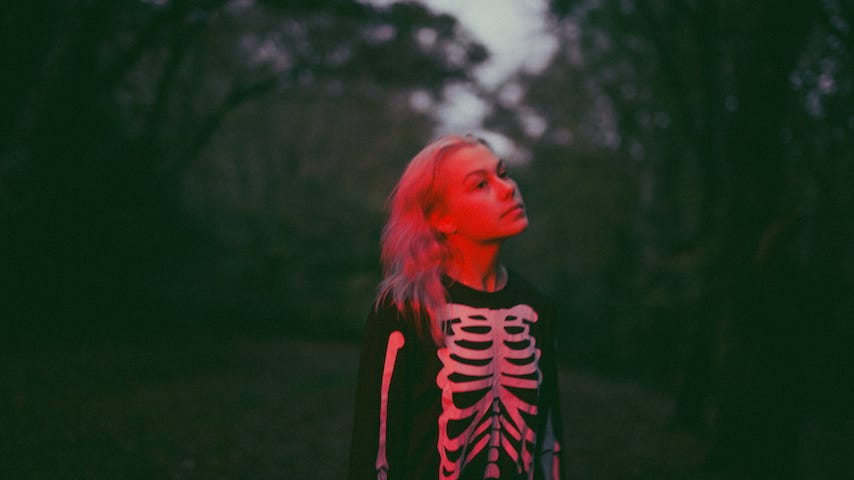
This month, the Picky Bastards team got together for a little experiment. Taking inspiration from it being Halloween, we picked Phoebe Bridgers’s classic track named after the holiday as a starting point, and then sent our team on a little journey. Joe Hoare, the first writer in the chain, was asked to listen to this song, and see what other song it made him think of – it could be through a memory the song evokes, a link between this act and another, or any other route through which the individual writer was led by their song.
And then the chain continued – with 8 writers involved, where would this spooky musical odyssey take us? Find out below:
Joe Hoare – Frightened Rabbit, ‘Boxing Night’
Halloween for most people is about gore, horror, and cheap costumes. A time to roll your eyes at another capitalist sham holiday or to throw yourself into it with abandon, fake blood and all. Phoebe Bridgers, however, reclaims it as a chance for reinvention and escapism, a modern Masquerade Ball. There is an excitement to choosing a costume – you’re standing on the edge of a world of opportunity and can “be anything”. Doing this with a loved one (this is instance, voiced by Conor Oberst) adds a further layer of exhilaration.
Musically, the song is delicately pared back, starting with gentle guitar picking, Bridgers’ soft vocal, and sporadic whirring. As the songs progresses, the song builds: more persistent whirs, some driving drums, and backing vocals creating a nuanced but pleasant wall of sound – the excitement of the season growing? It is a beautiful song in its subtlety, added to by the brief duet at the end with Oberst. There’s love to be found at Halloween.
Despite the fact I hate seeing Christmas tat in shops before Hallowe’en is over, I will be shoving a Santa-themed selection box in your faces in October. “Halloween” immediately made me think of “Boxing Night” by Frightened Rabbit. Both songs bring up strong – although completely opposite emotions – tied to a specific festival. For the optimism, love, and hope of Bridgers’ “Halloween”, there’s the dejection, loneliness, and pessimism of “Boxing Night”. Hutchinson paints a depressing Christmas scene: sat in his boxers, so drunk he wouldn’t notice the city burning, watching his phone waiting for something to happen.
“Boxing Night” also builds as the song progresses. It starts with a livelier guitar line and vocal than “Halloween”, creating a slightly manic feeling. This is furthered by the addition of backing vocals, electric guitar, percussion, and other soundscapey noises – by the end of the song it feels like it’s all become too much.
Both songs, for me, subvert our expectations of a holiday: Halloween becomes an exciting opportunity; Boxing Day becomes lonely and manic.
Fran Slater – Fontaines DC, ‘Dublin City Sky’
Well first of all, fucking hell – I proposed the idea for this article, choosing my favourite artist of the last ten years for the opening song. In no world did I expect that the next person would choose arguably my favourite musician of all time for song two – a leap from Phoebe Bridgers to Frightened Rabbit is something that makes me realise what connects Phoebe and Scott; both of these songs, and both artists, are able to conjure emotional reactions that most artists cannot.
Weirdly, as well, as a massive fucking Scrooge, I have a playlist called ‘Christmas songs that aren’t for dickheads’ that I play every Christmas morning. There are 11 songs on there. 4 are Phoebe, 3 are Scott. How did I not see the connection before?
But, anyway, my next connection takes us away from the holidays/seasons (even though it does have a verse about January that was an unintentional connection). While listening to ‘Boxing Night’, I heard Scott sing the lines ‘Good Glasgow could burn to it’s timber tonight/And I’d barely blink an eye’ and the first thing it reminded of was Grian Chatten singing ‘And in the foggy dew, I saw you throwing shapes around/it was underneath the waking of a Dublin City sky.’
I love an accent on a singer, especially when that accent is used on a song that evokes a city, a time, and a place. ‘Dublin City Sky’ by Fontaines DC is a great example of this, and the song conveys a similar emotional resonance to ‘Boxing Night’ – anchoring you in a place and a feeling that feels both particular and universal.
I wonder if whoever comes next on this list will be taken in a similar direction by this song. Let’s see.
Kate Burke – Bright Eyes, ‘Lua’
Can I please begin by echoing the “fucking hell” sentiment? I feel like this week has been full of surprises and synergy, and I’m here for it.
I must confess, I have not listened to Fontaines DC before, although they are on my list. That never-ending list that I keep adding artists to before replaying Oliva Rodrigo for the 200th time.
I’m never sure of an accent on a singer (sorry, Fran) and without prior knowledge, it took me by surprise. However, after a few plays through I stopped only hearing the accent, and started to properly hear, feel, and enjoy.
The idea of wandering city streets with your lover, questionable weather and an uncertain relationship, took me to ‘Lua’ by Bright Eyes. This was auspiciously cemented when Phoebe Bridgers joined Bright Eyes on stage in Nashville to perform it – the same night I had delightfully recapped seeing her support Conor Oberst early in her career, singing this very song. She may have started this thread, but she’s certainly not for leaving it.
As always, Oberst’s lyrics are what speak to me most. Hearing ‘Lua’ for the first time, I imagined myself as the subject matter; nights spent with possibilities and parties, but fragile, damaged, ‘you just keep going to the bathroom, always say you’ll be right back.’
I felt seen, in a way that I hadn’t been by an artist up until this point. Here was a talented songwriter, vocalising my very real feelings (see also ‘Hit the Switch’) and helping me find a way to try and make myself make sense. Bright Eyes very quickly became one of my favourite bands, and I would spend the next decade obsessed with “anything from Omaha” and Saddle Creek Records, chasing the high of musical connection.
While listening these days, I do worry if it might have encouraged me to romanticise my depression:
‘And I know you have a heavy heart; I can feel it when we kiss/ So many men stronger than me have thrown their backs out trying to lift it.’
…but to be fair, I was depressed and in my twenties, so I do need to give myself a bit of a free pass here. I did the work, eventually, and all of the gigs, records and “not another fucking black band tee” along the way have been worth every penny as therapy.
Another emotional reaction to add to the list!
Lisa Whiteman-Pearce – Phosphorescent, ‘Song for Zula’
The email came through from Picky Bastards in the middle of packing for a long weekend away, with a deadline of whilst I’m on that weekend away. Before reading further, I wondered if I would be able to listen, hear, longlist my associations, shortlist my associations, forget I’d been asked to do it, re-listen to the shortlist etc, particularly as I hadn’t heard Kate’s choice before.
I started somewhere I don’t usually start, for necessity more than design… the lyrics. I read and re-read Conor’s lyrics and immediately pictured the couple. The life. The choices. The habits. None of which explain away a genuine love, albeit unhealthy and unsustainable, a real, painful love. To make my choice, I waited until today so I could listen to it, and hear how it was delivered (and there was no surprise). I stood down my first option, which was a dirtier, heavier, sludgey painting of the same picture, to Song For Zula by Phosphorescent.
Matthew Houck isn’t telling us about a healthy love, or an unhealthy one. In this, he is describing the shut down after that love leaves, and the shutting away/down to avoid the risk of loving again. “I saw love, you see it came to me
It puts its face up to my face so I could see.Yeah then I saw love disfigure me
Into something I am not recognizing. See the cage, it called. I said, come on in
I will not open myself up this way again”
The friend who introduced me to this record, and the album Muchacho, years later described their final minutes with their then ex-partner, as they said goodbye and went in different directions, and how they held each other whilst this played. Almost promising, with Houck’s voice, that they’d never have this love again. Maybe a few of us have felt that, in the moment, that locking away because the hurt.. hurts. They came out of the cage, found a different love. I did. I hope most of us do.
I felt it when I first heard it. I felt it when they described that remarkably intimate, painful moment. Kills me then, kills me now.
Assignment complete. Im off for chips and the sea. Enjoy crying, bastards, because, to quote the last one, “fucking hell”.
James Spearing – Bat for Lashes, ‘Kids in the Dark
‘Song for Zula’ is immediately familiar. Not because I’ve listened to it before – I’ve never heard of the song or the artist. Not even because of the borrowed June Carter/Johnny Cash lyrics.
It’s familiar because it’s a four chord song.
You might not know what this means, but you don’t need a degree in music theory to recognise this chord sequence that you will have heard a million times, perhaps without realising. Still don’t beleive me? Watch this video. Four chord songs are everywhere, and this is yet another (albeit Phosphorescent occasionally throws in a fifth chord for variety).
So my immediate thoughts were ‘Let It Go’ from Frozen and ‘Don’t Stop Believin” by Journey, but I thought better and will spare the next writer from having to listen to these. I thought then I could pick something four-chordy but more tolerable. ‘No Woman No Cry’ perhaps?
Instead, I went with something that the overall sound and mood of the song reminded me of instead. And incidentally it’s a song that also has four chords (different chord sequence though) and is from a concept album about vampires, so in keeping with the original theme of this chain.
Like ‘Song for Zula’, ‘Kids in The Dark’ is laid back, synthy and melancholy. I would also say haunting but that might be too on the nose for this seasonal celebration. And across the rest of the album Lost Girls is a similar sense of love and pain being intertwined.
Next writer take note: with winter on the way, we might need a happier pick.
Rick Larson – The Courtneys, ‘The Lost Boys’
James chose a song I had not heard by an artist I don’t know in a genre, synth pop, that I haven’t really willingly listened to at all since I was working as a waitress in a cocktail bar, that much is true. Two notes on the video as I search for inspiration: (1) the lead girl vampire can do a lot better than that goofy guy, and (2) I’m concerned that she’s a bit cavalier about the staying out of sunshine thing. The girls all seem to be just out enjoying a vampire weekend. No, too easy.
I did enjoy James’s foray into music theory, which fascinates me especially on the rhythm side. Much like so many songs follow that chord progression an even greater number are built on the backbeat rather than the downbeat: the snare snaps on the second and fourth beat. (In reggae, the third is preeminent) It’s harder to choose a rock song that doesn’t have this backbone, so that part is easy. Let’s continue the theme and pick a song about teenage vampires!
The great under-listened-to British Columbian fuzz pop, Dunedin sound inspired trio The Courtneys pay tribute to The Lost Boys, the Eighties teen vampire movie (filmed in my childhood home of Santa Cruz, CA). The backbeat is steady here, surrounded by rumbling eighth notes on the floor tom and then ringing ones on the ride cymbal, accentuating the drama and perils of young love, especially when your boyfriend lives forever. The song also features what is the apex of our species: a woman drummer who sings lead.
Fat Roland – Aphex Twin, ‘Rubber Johnny’
In this charade of a musical exquisite corpse, I have been foisted with Lost Boys by Vancouver fuzz-popsters The Courtneys. I’m not sure why. Something about vampires and the 1980s. The video is a live performance on KEXP, a Washington state indie music broadcaster who called themselves KEXP because their full name Kenneth’s Erotic Xylophone Players wouldn’t fit onto a DAB digital radio display. The lead singer is singing, drumming and wearing stripes, which is a level of multitasking that would send my brain into meltdown.
Rick discussed the perils of young love and evoked his childhood in Santa Cruz. I can bring no such romanticism to this website series. I was raised in an industrial skip round the back of a Manchester needle exchange, and my only friends were urban squirrels who would tentatively approach my wet bin in the hope of snaffling discarded takeaway burgers. I’m not a “Lost Boy”; I’m a rambling manchild, and if I was ever in the presence of those cool college kids in The Courtneys, I would shatter in embarrassment.
I will take Rick’s vampires and tip us headfirst into true horror. Chris Cunningham’s video for Aphex Twin’s ‘Rubber Johnny’ is disturbing from the start. The scratchy night vision camera, the alien’s demented blathers, the Backrooms-esque dystopia of it all. “We’re not really getting anywhere, are we,” says the well-spoken interviewer before almost certainly getting his head ripped off by whatever is lurking in the shadows. I’m submitting this video as a whole: the music doesn’t start for over two minutes, by which time laser-splattered digital glitchcore is the least of our problems.
Well that was very disturbing. Indeed true horror as promised. From the monstrous creepy baby to its grown, locked up laser dancing and brain splattering form, I watched with a furrowed brow throughout. The onslaught of images of alien form Rubber Johnny contorting in his wheelchair and violently splatting his alien head on the screen combined with Aphex Twin’s glitch beeps make for stressful viewing. Certainly very unsettling, which is not a bad thing – it is good to be provoked. I found it particularly heartbreaking at the end when the door opens and an offscreen captor says “fuck’s sake, look at this prat”.
Poor Johnny!
My poor heart and nerves! I sought an immediate antidote and thus find myself going pathetically route one here with Dusty Springfield’s Spooky. Ah the soothing tones of dear Dusty. Mmm. A nice balm on the glitch brain splat frazzle. And yet! With Rubber Johnny in mind I am troubled by the sweet tones declaring that love is kinda crazy with a spooky little boy like you. If ‘Rubber Johnny’ is the full throttle horror, ‘Spooky’ is the naive foreboding that precedes a gory end. It is Drew Barrymore putting popcorn on the stove in the opening scene of Scream. True horror builds in anticipation, starting with the gullible heart that opens to a spooky little boy, that answers the phone again, that finds itself feeling sorry for a monster. The gentle ingenuity of Spooky feels haunting and I fear for what comes next. The antidote didn’t really work then.
Will Collins – Nancy Sinatra and Lee Hazlewood, ‘Some Velvet Morning’
Given our proximity to Halloween and the song’s title, I went into this assuming that my link would be something horror-related and I would probably go for something obvious, like John Carpenter’s theme from Halloween. But it was a different kind of horror (or at least unease) that came to mind as I listened to ‘Spooky’. Fliss mentioned the latent dread in the song’s lyrics, but I think that the music itself carries a little of that menace too. Although ostensibly a woozy slice of 60s pop soul, there is something slightly off in the gentle lounge stylings of the song. The longer it goes on, the less jolly everything feels and the more it takes on a slightly hallucinatory, unsettling feel. When the music stops and the finger clicks echo in the silence, the nightmarish underbelly of the song pokes through for the briefest moment, before disappearing again. All in all, it isn’t the jaunty listen it initially appears to be.
All of which made me think of another 60s song which seems on the surface to be simply a light, throwaway slice of easy-on-the-ear pop but reveals itself to be something weirder and darker: ‘Some Velvet Morning’ by Nancy Sinatra and Lee Hazlewood. The strings that kick the song off suggest it’s simply going to be a lushly orchestrated love song, but the track that follows is anything but. Instead, it morphs into a grandiose, psychedelic ballad with shades of Morricone’s spaghetti western soundtracks. The change in tempo and melody between Hazlewood and Sinatra’s parts is jarring and unsettling, taking the song even further away from being a simple declaration of love and suggesting something stranger and more unnerving about the relationship captured within. The lyrics, allusive and mysterious, hint at darkness in this relationship without bringing it fully out into the light for analysis. The song is all the better for it, a trippy masterpiece that gets under your skin and stays there.

